
Pre-Workout Ingredients Explained: What Actually Works?
If you’ve read our Best Pre-Workout in NZ (2026 Guide), you already know which products rank highest.
But understanding why they work is what separates smart buyers from impulse buyers.
This guide breaks down:
-
Which pre-workout ingredients are scientifically effective
-
Proper dosages based on research
-
What NZ gym-goers should look for in 2026
-
Which pre-workout ingredients are mostly marketing
This article is based on:
-
Analysis of 25+ pre-workout labels available in New Zealand
-
Established sports nutrition dosing standards
-
Position stands from the International Society of Sports Nutrition (ISSN)
-
Current caffeine safety recommendations
Quick Answer: What Are the Most Effective Pre-Workout Ingredients?
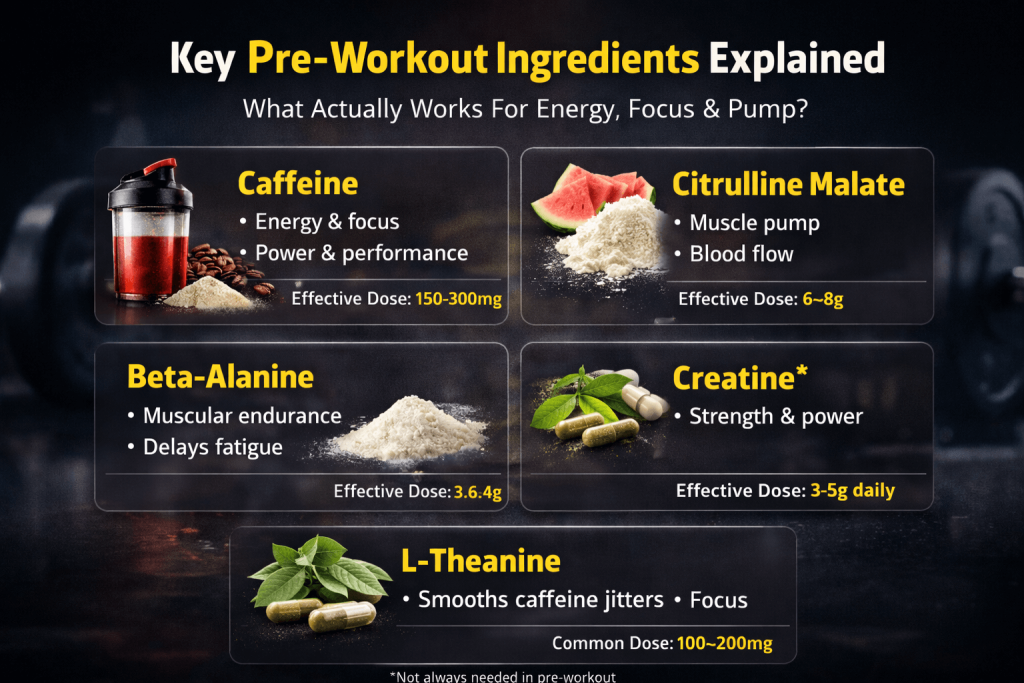
The most effective pre-workout ingredients are:
Caffeine (150–300mg)
Citrulline Malate (6–8g)
Beta-Alanine (3.2–6.4g daily)
Creatine Monohydrate (3–5g daily)
L-Theanine (for smoother energy)
If a formula does not contain properly dosed amounts of these, it is likely underpowered.
What Is in a Pre-Workout Supplement?
Most pre-workouts contain four main categories:
1️⃣ Stimulants
Increase energy and alertness.
2️⃣ Pump Ingredients
Increase nitric oxide and blood flow.
3️⃣ Performance Enhancers
Support strength and muscular endurance.
4️⃣ Focus Compounds
Improve mental clarity during training.
The effectiveness of a pre-workout depends on dosage transparency and evidence-backed ingredients, not branding.
Pre-workout Ingredient Breakdown
Caffeine – The Primary Performance Driver
What it does:
Improves power output, reaction time, and endurance.
Evidence:
The ISSN confirms caffeine enhances performance when taken at 3–6 mg per kg of body weight.
Effective range: 150–300mg
Advanced users: up to 400mg daily total intake (general adult safety guideline).
⚠️ NZ note: If you train in the evening, high caffeine can disrupt sleep quality — especially for shift workers or early starters.
The performance-enhancing effects of caffeine are well supported in sports nutrition research. According to the International Society of Sports Nutrition (ISSN), caffeine improves endurance, power output, and focus when used at appropriate dosages.
Citrulline Malate – The Most Effective Pump Ingredient
What it does:
Boosts nitric oxide, improving blood flow and muscle fullness.
Effective dose: 6–8g
Citrulline is superior to arginine due to better absorption and stronger plasma arginine increases.
If your product contains less than 4g, it is likely underdosed.
Beta-Alanine – Endurance Support
What it does:
Buffers lactic acid, delaying muscle fatigue.
Effective dose: 3.2–6.4g daily
The tingling sensation (paresthesia) is harmless and temporary.
It works through muscle saturation — consistency matters more than timing.
Creatine Monohydrate – Strength & Power
What it does:
Increases ATP production for explosive strength.
Effective dose: 3–5g daily
Creatine does not need to be in a pre-workout specifically. Daily intake matters more than timing. Creatine monohydrate remains the most researched form of creatine. If you’re looking for properly dosed options, you can explore our creatine supplements here.
Monohydrate remains the most studied and reliable form.
L-Theanine – Smoother Energy
Often combined with caffeine to reduce jitters.
Ideal ratio: 2:1 caffeine to L-theanine
Helps create smoother mental focus without crash.
When Should You Take Pre-Workout?
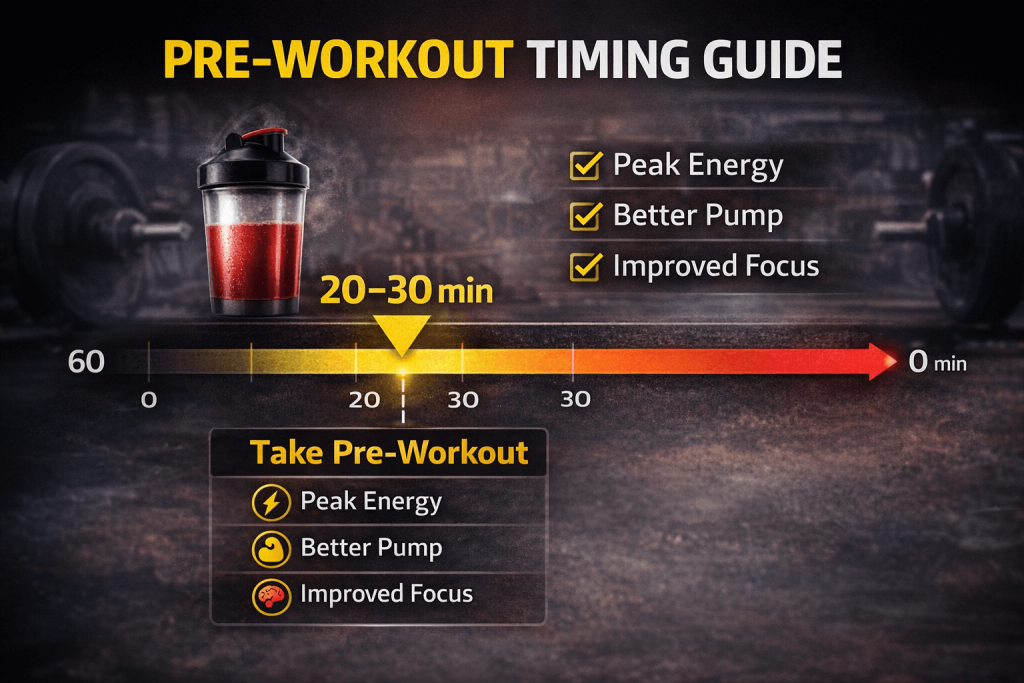
Most people should take pre-workout 20–30 minutes before training to allow caffeine and performance ingredients to reach peak effectiveness.
Why 20–30 Minutes Is Optimal
Pre-workout supplements typically contain caffeine, citrulline malate, beta-alanine, and focus-enhancing compounds.
Here’s how timing works:
Caffeine reaches peak blood concentration within 30–60 minutes.
Citrulline begins increasing nitric oxide within 30 minutes.
Beta-alanine works through long-term saturation but still contributes acutely.
Taking your pre-workout 20–30 minutes before starting your workout allows:
Peak energy during heavy lifts
Improved muscle pump during hypertrophy training
What Ingredients Are Mostly Marketing?
Be cautious of:
Proprietary blends (no dosage transparency)
Underdosed pump ingredients
Excess B-vitamins
Random herbal extracts without strong human research
Transparent labeling is a strong quality indicator.
How to Read a Pre-Workout Label
Before buying, check:
✅ Caffeine clearly listed
✅ Citrulline at 6g+
✅ Beta-alanine at 3.2g+
✅ No hidden blends
✅ Transparent serving size
Many weaker formulas rely on branding rather than dosing.
Now that you understand which ingredients matter, you can browse the best pre-workout supplements in NZ that meet proper dosing standards.
What Should NZ Gym-Goers Look For in 2026?
For most New Zealand lifters:
For Strength & Intensity:
-
250–300mg caffeine
-
6–8g citrulline
-
3.2g beta-alanine
For Evening Training:
-
Non-stim formula
-
6–8g citrulline
-
L-theanine
-
Electrolytes
Your ideal formula depends on:
-
Caffeine tolerance
-
Training schedule
-
Sleep sensitivity
Frequently Asked Questions
Yes, if total daily caffeine stays under 400mg. Consider cycling high-stim formulas to avoid tolerance.
No. The tingling sensation is harmless and caused by nerve receptor activation. It typically fades within 20–40 minutes.
Take pre-workout 20–30 minutes before training to allow ingredients to absorb and maximize performance.
No. Creatine works through daily muscle saturation and does not need to be timed before training.
Most healthy adults can tolerate up to 400mg per day. Performance benefits typically occur between 200–300mg pre-workout.
Citrulline malate at 6–8g is currently the most effective nitric oxide booster based on human research.
Key Takeaways
Proper dosing matters more than branding.
Citrulline (6–8g) is essential for real pump.
Beta-alanine requires daily consistency.
Creatine works best taken daily, not just pre-workout.
Transparent labels signal higher product quality.
Experience & Editorial Transparency
This guide is based on:
Review of 25+ pre-workout labels sold in New Zealand
Established sports nutrition dosing standards
ISSN position stands on performance supplementation
Practical gym application and ingredient comparison
Always consult a qualified healthcare professional before using stimulant-based supplements.
